Search is no longer limited to Google. Users are now asking questions directly inside ChatGPT, Gemini, Perplexity, Claude, AI browsers, and voice assistants. Instead of showing ten blue links, these platforms generate answers. That changes SEO forever.
If you haven't read our previous article, SEO After Google I/O 2026: What Changed and What Still Works, start there first. It explains why traditional SEO is evolving and why Answer Engine Optimization (AEO) is becoming the next layer of search visibility.
What Is AEO?
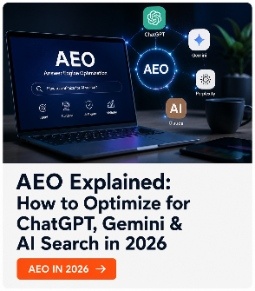
AEO stands for Answer Engine Optimisation. It is the process of optimising content so AI systems can understand it, retrieve it, trust it, summarise it, and reference it in generated answers.
Traditional SEO focused on rankings. AEO focuses on becoming the answer itself.
Traditional SEO focused on rankings. AEO focuses on becoming the answer itself.
Why AEO Matters in 2026
The way users search is changing rapidly. People now ask conversational questions, layered questions, follow-up questions, and comparison-based queries.
Instead of searching for "best CRM", users now ask: "What's the best CRM for a startup with remote sales teams and AI automation?" AI systems are designed for this behaviour. Businesses that fail to optimise for AI retrieval will lose visibility over time.
Search Engines Are Becoming Answer Engines
Google's AI Overviews already summarise information directly inside search results. ChatGPT and Perplexity synthesise information from multiple sources. Gemini integrates AI deeply into Google's ecosystem.
Visibility now depends on clarity, structure, authority, and semantic understanding — not just rankings.
How AI Systems Actually Retrieve Content
Most businesses still misunderstand this completely. AI systems don't read content like humans. They process content very differently — and the way you structure your content determines whether AI can actually use it.
AI systems process:
- Content chunks and discrete sections
- Contextual relationships between topics
- Entity connections and brand associations
- Semantic patterns and intent signals
- Information structure and formatting hierarchy
That means messy, unstructured content becomes harder for AI to interpret. Clear, well-organised content becomes far easier to retrieve and reference.
What AI Systems Prefer
-
1Direct Answers
AI systems prefer concise explanations. Start with the answer immediately before expanding deeper into the topic. Don't bury the key insight in paragraph five.
-
2Structured Formatting
Headings, bullet points, FAQs, numbered lists, tables, and summaries make content easier for AI systems to retrieve, segment, and reference in generated answers.
-
3Semantic Depth
Cover related concepts, answer connected questions, and build topic ecosystems instead of repeating keywords. AI rewards breadth of understanding within a subject area.
-
4Entity Optimisation
Help AI understand who you are, what your brand represents, and what topics you specialise in. Named entities — your brand, your team, your products — signal trust and authority.
AEO Strategies That Actually Work
The businesses that dominate AI search visibility are focusing on practical implementation rather than theory. Here are the four core strategies driving real results right now.
Write content around real user questions and natural language queries. Answer the exact way people actually speak.
Create interconnected content ecosystems instead of isolated blog posts. Depth signals authority to AI systems.
Implement structured data to improve AI understanding and content retrieval across every platform and engine.
AI systems trust recognised entities with strong reputations across multiple platforms, not just a single website.
Important Schema Types for AEO
Schema helps AI systems understand your content better and retrieve it more accurately. The most important schema types for AEO include:
- Organization — establishes brand identity and authority
- Person — builds author credibility and expertise signals
- FAQ — directly feeds conversational AI retrieval systems
- Article — signals content type and publication context
- LocalBusiness — essential for local AI search visibility
- Product — critical for e-commerce AI discoverability
- Review — adds trust and social proof signals
Schema is rapidly becoming a foundational layer of AI discoverability, not an optional technical add-on.
The Biggest AEO Mistake
Most businesses are still creating content only for rankings. That approach is becoming outdated quickly. Optimising for position one means nothing if the AI summary above it answers the question without anyone clicking your link.
The future belongs to businesses creating quotable insights, trusted expertise, structured knowledge, and genuinely conversational content. The goal is not simply traffic anymore. The goal is becoming the trusted source AI systems reference — the brand cited inside the answer itself.
Final Thoughts
AEO is not replacing SEO. It's becoming the next layer of it. Search is evolving from search engines to answer engines — and the businesses that adapt early will dominate the next era of visibility.
Because in the future, the most important ranking position may not be Position #1. It may be becoming the source AI chooses to trust.